
Wenchang ElectronicWire and cable solution provider

4News -> Industry
Industrial robots' wires can be classified into the following five categories based on their functions and application locations:
Power cable: Supplies power to the robot body and needs to withstand large current transmission. It is usually laid in a fixed manner and has high requirements for wear resistance and high temperature resistance.
Control cables: Transmit control signals to ensure precise movements of each joint of the robot, and they must have anti-interference capabilities and low latency characteristics.
Signal cables: Used for feedback of sensor data, such as position, temperature, pressure, etc. They must ensure stable signal transmission and be resistant to electromagnetic interference.
Network communication cables: These cables enable data exchange between robots and external systems (such as PLCs, upper computers), and common types include Ethernet cables and optical fibers. They must meet the requirements of high speed and low packet loss rate.
Composite cable: Integrates functions such as power, control, and signal transmission into one unit, simplifying wiring and suitable for robot systems with limited space.
II. Core Performance Requirements
Bend and torsion resistance: Frequent movement of the robot joints causes the cables to repeatedly bend and twist. Therefore, high-flexibility conductors (such as extremely soft copper wires) and fatigue-resistant insulating materials (such as TPE, PUR) must be used to ensure that the cables do not break during long-term use.
Environmental resistance: Capable of withstanding harsh conditions, such as resistance to oil stains, acids and alkalis, high temperatures (typically supporting a working temperature range of -40℃ to +125℃), and water and dust protection (IP67 or above).
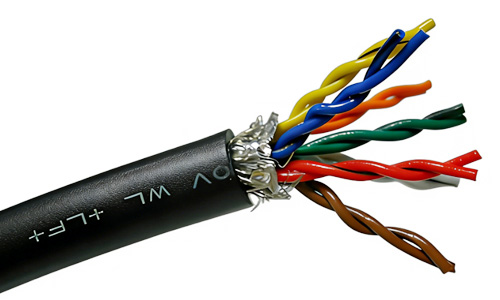
Anti-interference capability: By using a metal woven shielding layer or an aluminum foil shielding layer, electromagnetic interference is reduced to ensure the stability of signal transmission.
Lightweight design: Utilizing lightweight materials and compact structures to reduce the robot's load and enhance its motion flexibility.
Modular design: Facilitates quick replacement and maintenance, reducing downtime.
Industrial robots' wires can be classified into the following five categories based on their functions and application locations:
Power cable: Supplies power to the robot body and needs to withstand large current transmission. It is usually laid in a fixed manner and has high requirements for wear resistance and high temperature resistance.
Control cables: Transmit control signals to ensure precise movements of each joint of the robot, and they must have anti-interference capabilities and low latency characteristics.
Signal cables: Used for feedback of sensor data, such as position, temperature, pressure, etc. They must ensure stable signal transmission and be resistant to electromagnetic interference.
Network communication cables: These cables enable data exchange between robots and external systems (such as PLCs, upper computers), and common types include Ethernet cables and optical fibers. They must meet the requirements of high speed and low packet loss rate.
Composite cable: Integrates functions such as power, control, and signal transmission into one unit, simplifying wiring and suitable for robot systems with limited space.
II. Core Performance Requirements
Bend and torsion resistance: Frequent movement of the robot joints causes the cables to repeatedly bend and twist. Therefore, high-flexibility conductors (such as extremely soft copper wires) and fatigue-resistant insulating materials (such as TPE, PUR) must be used to ensure that the cables do not break during long-term use.
Environmental resistance: Capable of withstanding harsh conditions, such as resistance to oil stains, acids and alkalis, high temperatures (typically supporting a working temperature range of -40℃ to +125℃), and water and dust protection (IP67 or above).
Anti-interference capability: By using a metal woven shielding layer or an aluminum foil shielding layer, electromagnetic interference is reduced to ensure the stability of signal transmission.
Lightweight design: Utilizing lightweight materials and compact structures to reduce the robot's load and enhance its motion flexibility.
Modular design: Facilitates quick replacement and maintenance, reducing downtime.
Specializing in wire and cable manufacturers
contact way
-
product
Robot wire Automotive wire communication cable Drag chain cable Electronic wire Flat cable series power cord more -
About Us
company profilecorporate cultureCompany imagingcertificationvideo -
application
electricity architecture Industrial Traffic Communication new energy petroleum Medical -
news
Company Industry Questions -
contact us
contact way
 qr code
tel+86 0769-8550 0878
Dongguan Wenchang Electronic Co., LTD 粤ICP备15115360号 【admin】
